
A lot of SEOs learned on-page optimisation from Moz’s “Perfectly Optimized Page” graphic by Rand Fishkin. Title tag here, H1 there, keyword in the URL.
Nectiv recently rebuilt it for AI search, and it’s a great piece. But it’s built around an article page. Most of my work is on product pages, and they play by different rules.
This month I ran 966 product prompts through ChatGPT for my ChatGPT shopping report. On broad “best X” prompts, brand sites made up just 2.7% of citations. Publishers and review sites took most of the rest.
Brands still won the buying click, though. In sofas and mattresses, 65% to 71% of shop links went to brand sites, and product cards showed up in 60% to 86% of answers.
So a product page has a different job in AI search. It rarely gets cited at the research stage. It needs to be the page a model trusts with the facts once your product makes the shortlist: what it is, who it’s for, what it costs, whether it’s in stock and what happens if it doesn’t work out.
Here’s my version for an ecommerce product page. The mattress brand is made up. The checklist isn’t. The usual basics still apply: good images, a clear size selector, an obvious add to bag button, breadcrumbs and related products. This covers what changes when the thing reading your page is a model.
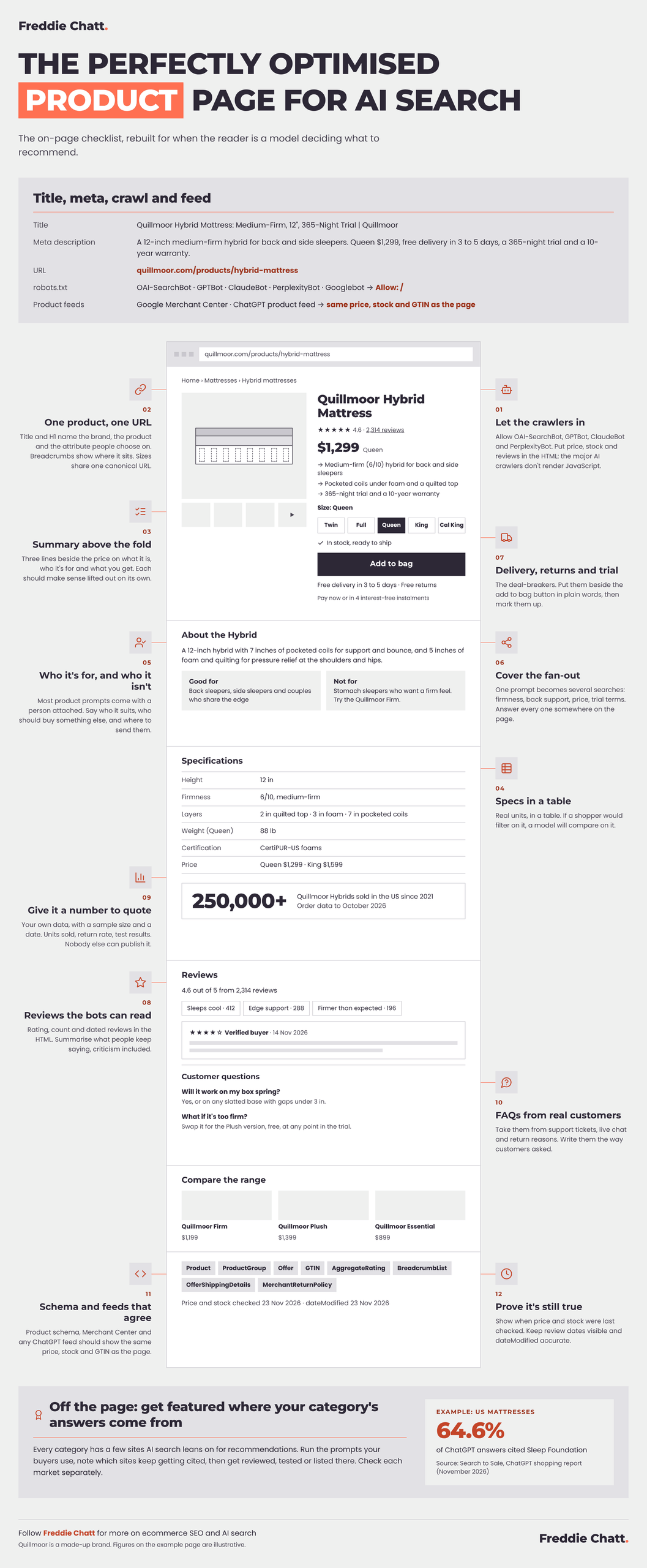
1. Let the crawlers in
Allow OAI-SearchBot, GPTBot, ClaudeBot and PerplexityBot in robots.txt. Check the right one, too. ChatGPT’s search answers are fed by OAI-SearchBot and ChatGPT-User, so blocking GPTBot alone doesn’t change your visibility there (Advanced Web Ranking).
Then make sure price, stock, specs and reviews are in the HTML. Vercel and MERJ found that none of the major AI crawlers render JavaScript (Vercel). On a lot of product pages, that’s exactly how the price and review widgets load.
2. One product, one URL
The title names the brand, the product and the attribute people choose on. The H1 matches it. Breadcrumbs show where it sits in your range. Sizes and colours sit under one canonical URL instead of spawning near-duplicate pages.
Example: Quillmoor Hybrid Mattress: Medium-Firm, 12″, 365-Night Trial at quillmoor.com/products/hybrid-mattress.
3. Put the summary above the fold
Three or four lines that answer “what is it and who is it for” before anyone scrolls. Firmness, who it suits, price, stock and the trial. Each line should still make sense if a model lifts it out on its own.
Example: Medium-firm (6/10) hybrid for back and side sleepers. Queen $1,299, in stock, free delivery in 3 to 5 days. 365-night trial and a 10-year warranty.
4. Specs in a table, with units
Models compare products on attributes. Give them those attributes in a table with real units. A spec hidden in a paragraph of marketing copy is easy to miss and easy to misquote.
For a mattress that’s height, firmness on a 1 to 10 scale, layer build, weight, certifications and price by size. If a shopper would filter on it, it belongs in the table.
5. Say who it’s for, and who it isn’t
Most product prompts come with a person attached. “Best mattress for side sleepers.” “Running shoes for wide feet.” Say plainly who the product suits, and who should buy something else.
The “not for” line feels risky. It’s also the line that makes the rest of the page believable, and it can point the wrong buyer to another product in your range.
Example: Not for stomach sleepers who want a firm feel. Look at the Quillmoor Firm instead.
6. Cover the fan-out
AI search breaks one prompt into several smaller searches. Google says AI Mode issues multiple related searches behind the scenes, including topics the shopper never mentioned (Search Engine Journal).
“Best hybrid mattress for side sleepers with back pain under $1,500” splits into firmness, back support, hybrid vs foam, price and trial terms. Your page should answer each one somewhere.
7. Delivery, returns and trial in plain words
These are deal-breakers, and models get asked about them constantly. Write them on the page in plain sentences: how long delivery takes, what it costs, how returns work and how long the trial runs.
Don’t hide them behind a policy link. Mark them up as shipping and return policy schema too (more on that in point 11).
8. Reviews the bots can read
Show the rating, the review count and recent reviews in the HTML. If your review app loads them with JavaScript, the AI crawlers in point 1 won’t see a single one.
Summarise what reviewers keep saying, including the criticism. “Sleeps cool (412 mentions), firmer than expected (196)” is useful to a shopper and easy for a model to repeat.
9. Give it a number to quote
Every competitor lists the same specs. Your own data is the bit nobody else can publish: return rate, the share of customers who keep the product after the trial, test results, how many you’ve sold. Add a sample size and a date so it can be checked.
Example: Over 250,000 Quillmoor Hybrids sold in the US since 2021 (order data to October 2026).
10. FAQs from real customers
Pull the questions from support tickets, live chat, return reasons and sales calls, then write them the way customers asked them. They match how people prompt, and they’re what your product page usually doesn’t answer.
For a mattress: Will it work on my box spring? Does it smell when you unbox it? What if it’s too firm?
11. Schema and feed that tell the same story
Mark the page up with Product schema: brand, GTIN, price, availability, rating, shipping details and return policy. For sizes and colours, Google supports ProductGroup with variesBy, hasVariant and productGroupID to group variants under one parent (Google Search Central).
Then check your feeds. Google’s AI Mode shopping draws on the Shopping Graph, which is fed by Merchant Center (Google, Shopify). ChatGPT can use merchant product feeds alongside public web sources (OpenAI), though feed onboarding is currently limited to approved partners (OpenAI).
The page, the schema and the feeds should all show the same price, stock and GTIN. When they disagree, you’ve given the model a reason to doubt all of them.
12. Prove it’s still true
Prices change, stock runs out and reviews age. Show when price and stock were last checked, keep review dates visible and keep dateModified in your schema accurate.
In my study, the content ChatGPT cited for mattresses and running shoes had a median age of 44 to 64 days. Out-of-date facts are easy to replace.
Off the page: get featured where your category’s answers come from
The biggest lever sits outside your site. Every category has a handful of sites that AI search leans on for recommendations, and your product page can’t stand in for them.
Find yours by running the prompts your buyers use and noting which sites keep getting cited. Then work out how to get reviewed, tested or listed there. Check each market separately: in my study, the UK and US top 20 cited sites barely overlapped.
Example: for US mattresses, Sleep Foundation was cited in 64.6% of ChatGPT answers. If you sell mattresses in the US, being in its reviews matters more than anything on this list.
A note
There’s no perfect product page, and no AI ranking to game. This maps where the effort pays off when the thing reading your page is a model deciding what to recommend. Quillmoor and its numbers are made up.
If you want this checklist run on your own product pages, join my waitlist.
Sources
- The Perfectly Optimized Page for AEO, Nectiv
- ChatGPT shopping report, Search to Sale (966 prompts, UK and US, November 2026)
- The rise of the AI crawler, Vercel and MERJ
- What AI search crawlers read, Advanced Web Ranking
- Query fan-out in AI Mode: new details from Google, Search Engine Journal
- Product variant structured data, Google Search Central
- Agentic checkout and AI shopping, Google
- Google AI shopping, Shopify
- Submit product feeds and Get started, OpenAI Commerce docs